
Severe Cold and Flu : How to Tell the Difference
Are you suffering from a runny or stuffy nose, muscle or body ache, sore throat, cough, and headache? Oh, okay, these symptoms may be signs of a cold or flu, but don’t worry. Severe cold and flu can also be treated if you find the difference between them.
But it is very difficult to find the difference because cold and flu share many common symptoms. You cannot differentiate them based on symptoms alone. Cold symptoms are very mild compared to flu. Flu can be confirmed by special medical tests.
In this article, I have explained everything in a simple way with practical examples, based on trusted sources like Centers for Disease Control and Mayo Clinic.
Basic Difference Between Severe Cold and Flu
Cold |
Flu |
| Caused by a number of different viruses | Caused by the influenza virus only |
| Mild symptoms | More severe symptoms |
| Do not result in severe health problems | Result in serious associated complications |
| can be confirm by symptoms | can be confirm by medical tests only |

Know about Common Cold
If somebody around you as a cold, he must carry a kerchief to cover his nose and mouth because, in the common cold, the most affected parts are the nose and throat. It is very common and harmless.
Do you observe that, as an adult, you may have 2 or 3 colds in a year, but infants and young children may have colds more often in a year? Now, if you have symptoms of a cold, you can recover within 7 to 10 days, and if you have a smoking habit, the symptoms might last longer.
If you have normal symptoms of a common cold, then there is no need for medical care. If the symptoms get worse, then medical care is required.
Symptoms of Common Cold
After you are exposed to a cold virus, common cold symptoms start within 1 to 3 days. You may find the symptoms below
- Runny or Stiffy nose
- Sore or scratchy throat
- Cough
- Sneezing
- Generally feeling unwell
- Slight body ache or a mild headache
- Low grade fever
Note:
The mucus from your nose may start out clear, then become thicker and change to yellow or green. This change is normal.
When to see a doctor for adults
Commonly, there is no need for medical care for a common cold, but if you have the below-mentioned conditions, please contact a doctor nearby.
- Symptoms that get worse
- Fever greater than 101.3°F that lasts more than 3 days
- Fever returning after a fever-free period
- Shortness of breath
- Wheezing
- Intense sore throat, headache, or sinus pain
When to see a doctor for children
Most children with a common cold do not need to see a medical professional, but if a child has any of the following, they need immediate medical care:
- Fever of 100.4°F in a newborn up to 12 weeks
- Rising fever or fever lasting more than 2 days in a child of any age
- Trouble breathing or wheezing
- Ear pain
- Fussiness or drowsiness
- No interest in eating

Know about Flu (Influenza)
Flu is a contagious respiratory illness caused by the influenza virus. Usually, when you have symptoms of a common cold, you may wonder whether it is a cold or the flu.
This concern is common because the flu is a little more dangerous than the common cold. The main reason is that the flu can cause mild to severe illness and, at times, can lead to death.
Symptoms of Flu (Influenza)
You may observe that flu symptoms come on suddenly. You can find the symptoms below:
- Fever or feeling feverish/chills
- Cough
- Sore throat
- Runny or stuffy nose
- Muscle or body ache
- Headache
- Tiredness
- Some people may have vomiting or diarrhea, and it is more common in children
Note: Not everyone with the flu will have a fever.
Complications of Flu (Influenza)
If you observe most people who get the flu, they may recover within a few days to less than two weeks. However, in some people, complications may develop, and in some cases, these can be life-threatening and may result in death.
Pneumonia is a serious complication of the flu, and it may result either from the flu virus itself or from a co-infection of the flu virus and bacteria. Sinus and ear infections are also examples of moderate complications of the flu.
Some complications of the flu include inflammation of the heart, brain, or muscle tissues, as well as multi-organ failure. If the flu virus affects the respiratory tract, it may cause an extreme inflammatory response in the body, which can lead to sepsis, the body’s life-threatening response to infection.
It can also make chronic medical problems such as asthma and heart disease worse.

Who are at higher risk from flu
The below-mentioned people should take extra care and be under the guidance of a qualified doctor because they have a higher risk from the flu. They are:
- People 65 years and older
- Those suffering from chronic medical conditions such as asthma, diabetes, or heart disease
- Pregnant women
- Children younger than 5 years
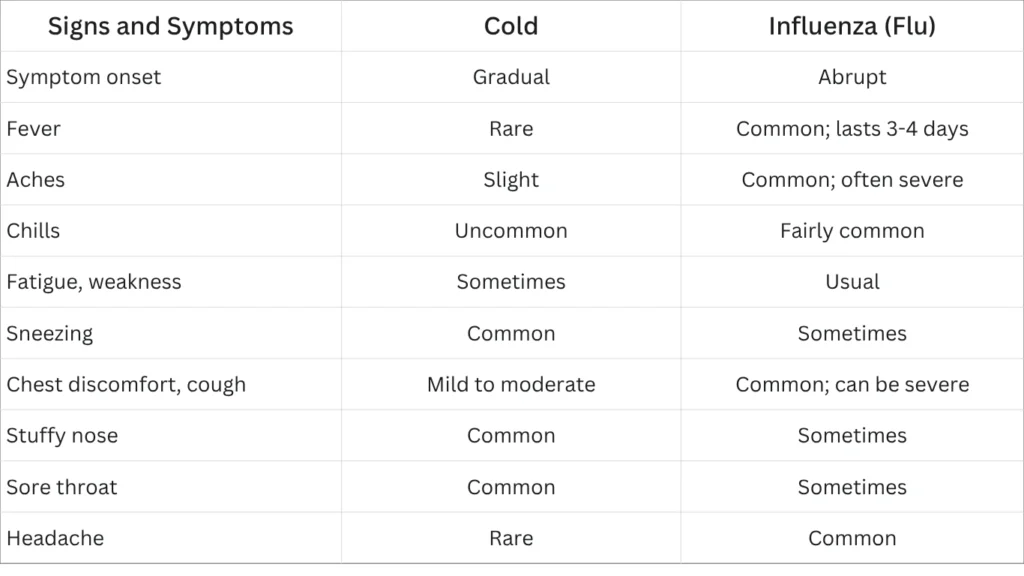
Differences of Severe Cold and Flu Symptoms
Here you can find the differences between symptoms of Severe cold and flu in below chart.
Emergency warning signs of Flu complications in Children
If you observe these warning signs, then you need contact qualified doctor on urgent basis.
- Fast breathing or trouble in breathing
- Bluish lips or face
- Ribs pulling in with each breath
- Chest pain
- Severe muscle pain
- Fever above 104F which is not controlled by medicine
- In children younger than 12 weeks any fever
Emergency warning signs of Flu complications in Adults
These are the warning signs, if you observe then immediate medical support should require.
- Difficulty breathing or shortness of breath
- Persistent pain or pressure in the chest or abdomen
- Not urinating
- Severe muscle pain
- Seizures
- Severe weakness or unsteadiness

Preventing Tips for Cold and Flu
As per the Centers for Disease Control and Prevention, If you follow below mentioned preventing tips you may avoid from cold and flu
- Every one that is 6 months and older should get a flu vaccinee in every season, especially people who are at higher risk
- Avoid close contact with people who are sick
- If you are sick, limit contact with others as much as possible
- Cover coughs and sneezes Wash your hands regularly
- Avoid touching your eyes, nose and mouth
FAQs
Cold and flu have similar symptoms, but why can the flu lead to complications?
- Flu virus is very stronger than common cold viruses
- It affects lungs and immune system
- The flu triggers a strong inflammatory response in the body
How effective is the flu vaccine for high-risk individuals?
- Reduces the risk of infections
- Protects against complications
- Lowers hospitalization risk
- Provides community protection
Is there a specific season for the flu virus?
Flu is most common during the colder months, that is, fall and winter, because people stay indoors more, increasing close contact. More importantly, the virus survives better in cooler or humid conditions.
References
Mayo clinic – Common cold causes, symptoms.
Centers for Disease Control and Prevention – Flu symptoms and differences between cold and flu, warning signs for complications and preventing tips.
Conclusion
Viral infections such as cold and flu have symptoms that are very important to monitor because the flu is more dangerous than the common cold. The symptoms may be similar for severe cold and flu, but there is a slight difference.
Cold symptoms are usually mild, whereas flu symptoms can be moderate to severe and may lead to complications, including death. Therefore, it is very important to take the flu vaccine seasonally, especially for high-risk individuals, and by following preventive tips, you may avoid cold and flu.
Disclaimer
This information about severe cold and flu in this article is for general awareness and educational purposes only. It is not a replacement for medical advice, and if you have any symptoms of cold and flu or any complications.
it is necessary to contact a doctor on an emergency basis. The information provided is not intended for any treatment or suggestions.
3 thoughts on “Severe Cold and Flu: Symptoms, Complications and Prevention.”